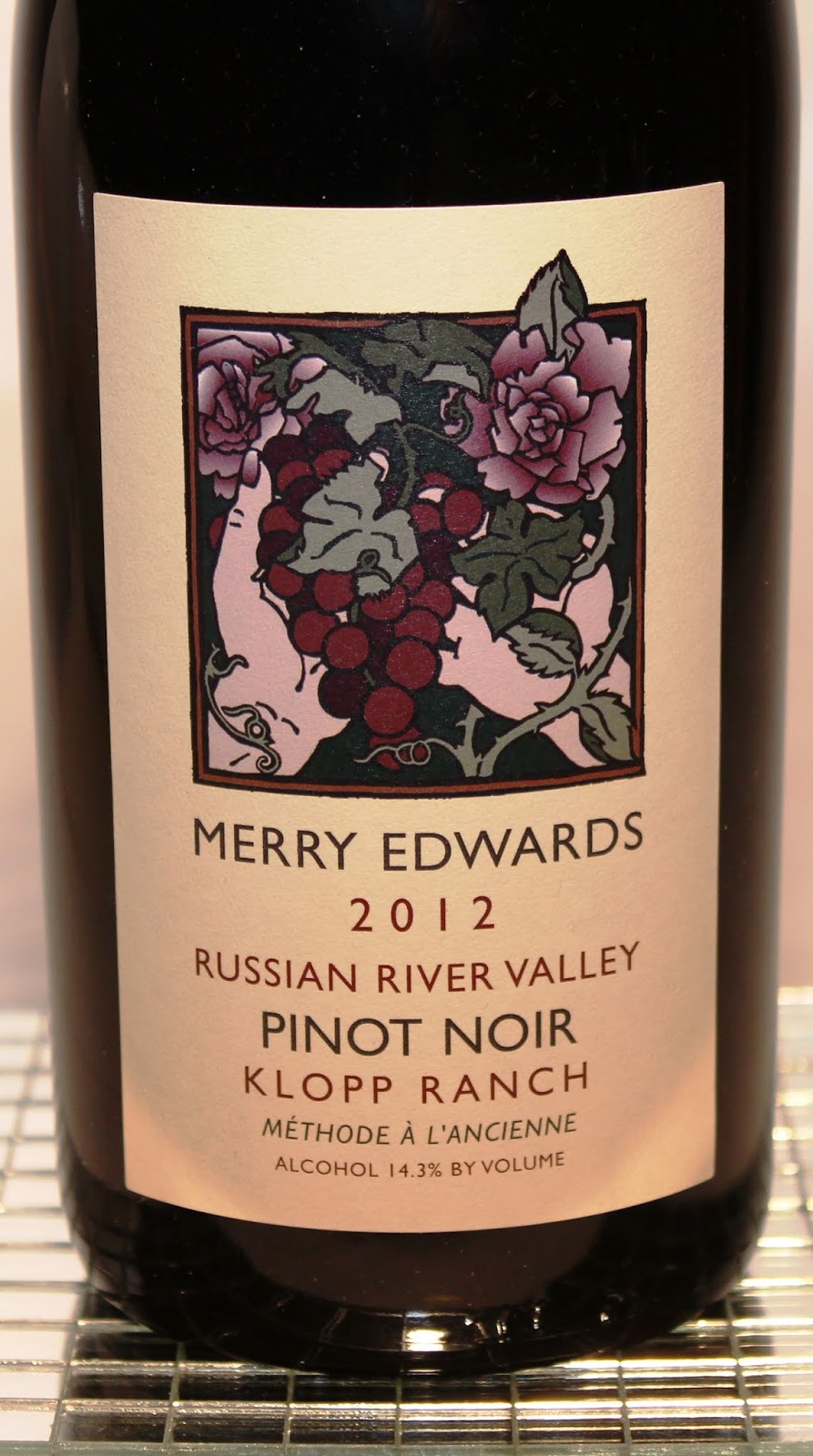
MERRY EDWARDS 2012 KLOPP RANCH PINOT NOIR, RUSSIAN RIVER VALLEY


"I think I'm simply too much of a Burgundian at heart to be able to appreciate fully whether Pinot Noir in other guises can be considered to achieve greatness.".....Benjamin Lewin, MW

I’m guessing Benjamin Lewis didn’t taste this wine. But do a search for quotes about Pinot Noir and you’ll see many experts expressing contrary opinions.  I was brought up at a time when most “good” wine available in the U.S, was from France and so I too was a Francophile.  Trips to Oregon and later California adjusted my outlook.  And now, I’m more involved with what is inside the bottle and less about where it was shipped from.  Rather than change allegiance, I prefer to think I’ve broadened my outlook.

Let’s be honest. There is a lot of bad Pinot Noir out there and people have made many millions of dollars producing it and then selling the brand.  But comparing a $20 bottle of that stuff to a quality offering of Pinot Noir is like equating a “Puddin’ Pop” to nanna’s home-made tiramisu. It’s just not a fair comparison.

Pinot Noir, thin skinned as it is, suffers from a bad attitude both in the vineyard  and in the winery.  Vines require constant attention and are susceptible to rot, mildew and viruses.  Clonal selections can increase yield (a shortcut).  Barrels are expensive.  And how long they are used is a cost factor.  It can be expensive to grow Pinot Noir and it can be expensive to produce and shortcuts don’t make for a good finished product.  And all along the way, Pinot Noir is just stubbornly capricious. But when it’s good, it is very good.  Sensual and suggestive, charming, transparent yet mysterious. 


I’m reminded of my own saying that “Every palate is personal and correct for the person owning it.” If you like Puddin’ Pops, that’s fine.  But it’s only fair that you acknowledge it cost more to make the tiramisu than the pop.  It’s also fair for people like me to acknowledge that the world standard of Pinot Noir remains in the Cote de Nuit where Domaine de la Romanee-Conti is produced and, depending on the vintage, comes with a price of $7,000- $12,000 (and more) per bottle. You can also get, for just $234, a bottle of Domaine des Lambrays Clos des Lambrays. And for only $26.95, a bottle of 2015 Louis Latour Cote de Nuit-Villages.


The point being terroir does make a difference - yes.  But so does demand. And so does, for some, image.  And so does one’s ability to afford the higher end stuff.  But can we at least slough off the quick dismissal of any Pinot Noir not from the Cote de Nuit and pay attention to what’s inside the bottle rather than only where it was shipped from?

Wines Readied For Tasting
In California, in the cooler growing area of the Russian River Valley, is where Merry Edward grows and produces the Klopp Ranch (single vineyard) Pinot Noir.  But, like Grandma Moses, Merry didn’t start young at her particular genius, nor did she have the advantage of growing up in the family business. While a physiology major at Berkeley, she bought fruit at the farmers market and played at making wine. It proved popular After college, she attended the enology graduate program at UC – Davis.  Later, she ran a 25-acre vineyard and did everything she could to learn the business. At age 50, she was forming a company to produce wines in Sonoma, met a fellow rafter (she was rafting in the Grand Canyon) whom she later married. He had a degree in agriculture and for ten years they made wine in a rented facility.  Eventually, they built their own winery.

Making Tasting Notes At The Table
I visited the winery in October of 2014 and was grateful for the extreme courtesy of a private tasting away from the busy tasting room, allowing me time to better appreciate (during their very busy season) what it was I was tasting.  The wines were amazing. And when I recently opened this bottle of “Klopp Ranch” 2012 it brought me back to that glorious tasting. But the wine spoke on its own.


To aromas of dried candied fruit, but with a savory note. Burnt cherry, but brandied fruit. Forrest floor (old world and with some mushroom), white pepper.  Floral notes of rose petal and lavender/violet. Tastes of cherry, sure – it’s Pinot Noir, but different, mysterious. Plum, white pepper, dried fruit, cardamom.  Some tannin but spread evenly across the entire palate and ever so gently, lifted by the wine’s clean acidity yet seamlessly. Everything about this Pinot Noir is different. Layers of cherry but with earth. Bright but earthy. Whispered hints of strawberry lighten the truffle hint.  Anise?  Floral notes of violet meld with light wood. There’s a mix of minerality against brambled berries opposed themselves by black tea. This is indeed complex, intriguing, mysterious and a wine you want to keep tasting just to understand; a Flying Wallenda of balance.

Methode a l’Ancienne is used on this bottle’s label. It means a “minimalist approach to winemaking”. Interestingly, that approach is exactly that used by the “winemakers” – they don’t like the term “winemakers” in the Cote de Nuit.  Instead, it’s all about terroir.  Indeed, there are other California Pinot Noirs I enjoy (3 others?) and include another from the Russian River Valley.  But something about this wine by Merry Edwards makes it stand out even from others she produces, despite that I enjoyed them all.  So while terroir may always remain the genesis of disputes (after all, “Klopp Ranch” is a single vineyard), and while Merry Edward herself refers to a “minimalist approach,” my palate tells me she isn’t taking enough credit.  For this Francophile, it will remain one of my favorite “Burgundies” and very well-priced by comparison. 

Cheers!
……………….. Jim

Follow and “Like” Wine Mizer on Facebook for mini-reviews, industry news and more.

Winemizer,net does not accept any advertisements, nor is it affiliated with any winery, vineyard, importer or distributor.  You may be assured that any opinions are not economically biased (though they may not be appropriate to your individual and unique palate).

TECH SPECS & ETC.
2959 Gravenstein Hwy N, Sebastopol, CA 95472

Varietal:                      Pinot Noir, 100%

Clones:            Uncertain (by me), likely: Dijon 115; Martini, a mix of California & Burgundian          clones including the “Swan” clone – a Pommard selection.  If I can get more specific, I’ll update in the comments section

Fermentation:          Partial whole cluster pressing. (My opinion: Lifts fruit and freshness). Others note “adds spiciness”.
Aging:                        10 months French Oak, 63% new.
ALC:                          14.3%
Produced, Bottled By: Meredith Vineyard Estate
REVIEWS
Wine Enthusiast:         93 Points, rated a “Cellar Selection”
Wine Spectator:          90 Points

NOTES
Drinkable Through:     2022 (with good storage conditions)
Paid $60 at the winery. Current ARP $86, But have seen for $60 w/o tax & shipping                                                                                  

SCHARFFENBERGER NV “BRUT EXCELLENCE” SPARKLING WINE


“Some sparkling wines are Champagne without the geography…. or the price tag.” …… James McMillan


At the risk of being taken for a snob, I’ll admit to preferring French Campaign – or something intended to be entirely different (like Prosecco).  There are exceptions, of course, and I’ve written about some domestically made sparklers (on my Facebook page [like “Etoile” Brut from Domaine Chandon] and on this blog (see https://www.winemizer.net/2018/04/domaine-chandon-etoile-brut-sparkling.html)].  Now it’s time to mention another: Scharffenberger Cellars' “Brut Excellence”.  

Scharffenberger began in 1981 in the village of Philo in the heart of California’s Anderson Valley. Only a few miles from the Pacific Ocean, the area benefits from the region’s noted sunshine moderated by the cooling fog coming into this protected valley from the coast. 
It is where, on their 120-acre vineyards, Scharffenberger grows the Pinot Noir and Chardonnay grapes used in making their Brut Excellence. 1   The location itself explains the “French Connection” in California with French Domaines (Moet & Chandon, Mumm, Roederer and others) buying land in California and making Sparkling Wine within the U.S., or working in partnership with established wineries.  Under these and other labels (with differences noted on them) you may choose to purchase the product made in California or France.  Each will be made according to Champagne standards.

Scharffenberger has no “French Connection” I’m aware of though I doubt Gene Hackman would refuse a glass.  It is, however, made in the methode traditionelle (traditional method), or methode champenoise (Champagne method) meaning fermented twice in bottle.  You may see terms like metodo classico on sparkling wines from Italy, Cava from Spain or even Cremant (Also from France but not made within the designated Champagne region).  Ageing requirements may differ, but be assured it is made in the twice-fermented-within-the-bottle style.  

And while neither the name Scharffenberger nor the winemaker’s names (previously Tex Sawyer, now Jeffrey Jindra) bear much French resemblance, this sparkling wine is classically made and offers very good value.  “Creamy and lively, with festive apple and spice flavors,” says Wine Spectator.  One of the Top 100 Wines (of 2013) per the San Francisco Chronicle. A wine that’s remarkable for the money, says me.


On the nose, aroma of green apple and kiwi bathed in lactic acid. There’s a “sour” gooseberry-like note that is difficult for me to narrow down more precisely but I found it very pleasant. Regardless, a note of plum fruit and Rainier cherry balances this perfectly. On the palate, I loved the yeasty introduction of brioche with lemon (another taster said “lemon curd”). My opinion? The “curd” reference is more apt to the wine’s creamy texture from the juice resting on its lees for almost two years and the wine undergoing 100% malolactic fermentation.

The wine is dry (Brut, my favorite) and complex with notes too of almond and lychee nut. Fine, persistent bubbles. Other tasters said they enjoyed flavors of Bartlett pear, fig and mandarin orange. (I get the pear now that they mentioned it). Either way, at about $17, this sparkler screams out value. About two-thirds Pinot Noir and one third Chardonnay from their own vineyards and others nearby1 in cool growing Mendocino County (Anderson Valley) California. (Another reviewer reversed this percentage2. I’m going with the information provided by the winery itself as to the percentage of Pinot Noir and Chardonnay).

If you find many sparkling wines (or Champagne) too acidic and crisp, while Scharffenberger’s Brut does provide a crisp clean finish, it is rounded and creamy with vanilla notes and smoothed in its texture with surprising body.  It’s fresh, yet richer and deeper (yet with subdued fruit flavors) than other wines similarly priced. I found it lacking in nothing and with excellent, spot-on balance.

I tasted the wine without pairing it, but would suggest it is a (if not the) perfect match for trout amandine. Consider also, breast of chicken in a creamy white sauce, stuffed mushrooms or better yet deviled eggs topped with caviar/roe for the saltiness. 

Cheers!
………………. Jim

Follow and “Like” Wine Mizer on Facebook for mini-reviews, industry news and more.

Winemizer,net does not accept any advertisements, nor is it affiliated with any winery, vineyard, importer or distributor.  You may be assured that any opinions are not economically biased (though they may not be appropriate to your individual and unique palate).

ETC:
Scharffenberger Cellars                      http://scharffenbergercellars.com/index.html
1)      Scharffenberger Cellars also has long-term contracts with select vineyards within greater Mendocino Country and from whom they may source grapes. The same practice is used in Champagne.
2)      Another reviewer stated the blend as two-thirds Chardonnay and one third Pinot Noir. My source for the blend is from the winemaker’s notes: “The wine is approximately two-thirds Pinot Noir and one-third Chardonnay.”
Appellation:                                         Mendocino County
Fermentation:                                      Twice in bottle
                                                            100% Malolactic
Aging:                                                 On Lees, Average 2 Years
pH:                                                      3.27
ALC:                                                   12%
Exclusively represented by Maisons Marques & Domaines USA 
Ratings:                                              91 Points Wine Enthusiast,  
                                                           90 Wine & Spirits Magazine


UCCELLIERA BRUNELLO di MONTALCHINO 2006


Anni e bicchieri di vino non si contano mai” (Age and glasses of wine should never be counted”) ….. an Italian Proverb


Sometimes the “pro” reviewers and I agree. Sometimes we don’t, or I may think a wine has been over or under rated.  But this wine is one on which everyone agrees.  A 2006 Brunello di Montalcino from Uccelliera  (Azienda Agricola Uccelliera). If you’re unfamiliar with Brunello, know that it is made from Sangiovese, that same grape that makes for the Chianti you so enjoy. 

Brunello di Montalcino indicates it is of Montalcino.  Montalcino is south of Chianti in Tuscany and it is its own DOCG.  The climate is warmer, producing grapes that are riper (and with the potential for higher alcohol).  Being grown at higher altitude, berries are smaller producing thicker grapes with a higher skin to pulp ratio and, therefore, wines with more tannin. 


Brunello also has different aging requirements than does Chianti (even its DOCG). These are not wines to drink now.  But are they worth the wait?  Oh yes!  Deep purple in the glass and taking on coppery age tones at the rim, the nose on this Uccelliera is strong with brandied black cherries and fresh-cut, purple plum with a hint of green pepper.  The palate is immediately alerted with tart cherry but smooths out soon, and with air the texture becomes pure glycerin. Black cherry develops, notes of dried fruit and sweet tobacco contrast herbaceous hints.  Others get strawberry and raspberry. Complex, focused, precise and incredibly delicious. I allowed it an hour in the bottle and another in the decanter and it could have used even more, but didn’t hold up well for the next day despite being vacuum pumped.  Nonetheless, a pleasure to experience and next time, I’ll just have to finish the bottle. 


I served it with a simple green salad, basil-pesto stuffed chicken breasts and a side of zucchini cooked with sweet onion and tomato.  (The harvest of my and my friend’s garden calls and I answer).  But mostly, I intended to enjoy this wine today and mostly I cooked what I had on hand. As a rule, Sangiovese compliments all such tomato rich dishes and whatever the meal is, it is elevated by Sangiovese.  This particular Sangiovese wine lifted it almost out of reach! 

Salute!
………….. Jim

Follow and “Like” Wine Mizer on Facebook for mini-reviews, industry news and more.

Winemizer,net does not accept any advertisements, nor is it affiliated with any winery, vineyard, importer or distributor.  You may be assured that any opinions are not economically biased (though they may not be appropriate to your individual and unique palate).

Note:
90 Points James Suckling,  96 Robert Parker’s Wine Advocate,   94 Wine Enthusiast  93 Wine Spectator.  Drinkable 2014-2026.  ARP at time of purchase $56 (now $72) found as a close out for $50.  Imported by deGrazia Imports LLC (Winston-Salem NC).  ALC: 15%.
                                                                                    

SEGHESIO “CHIANTI STATION


“Chianti improves with age. The older I get, the better I like it”.  … Author Unknown

 HOW DO YOU WANT YOUR FETTUCCINI? With sausage and a garden-picked tomato and a slice of Parmesan Reggiano? Maybe meatballs instead and heavy on the basil in the pasta? Or “old school” with petite green peas and Buffalo Ricotta cheese only? (and, of course, some Parmesan shavings). Whichever you choose, I’ll make it however you prefer as long as you are open to tasting a domestic Chianti-style wine with the fettucchini.


This 2011 “Chianti Station” from Seghesio Family Vineyards has done nothing but get better with time in the bottle since I bought it at the vineyard in 2014, and it’s drinkable though another year. Seghesio makes many wines, being famous for Zinfandel (“Home Ranch”). Called “Primitivo” in Italy, Zinfandel is a grape the Italian immigrants were familiar with when they settled in Central California in 1881. Sangiovese, the principal grape of Chianti, is another varietal those same early Italian immigrants were familiar with.

“Chianti Station” is a vineyard in the Alexander Valley sub-AVA within the Sonoma County AVA. The grapes (Sangiovese and Canaiolo) were first planted in “Chianti Station” by the Seghesio family in 1910. They had been growing grape vines in Sonoma since 1895.  At $48, when I bought it at the winery, it was an expensive proposition, but delicious and interesting. The field blend used in producing “Chianti Station” may be comprised of (mostly) Sangiovese with Canaiolo and some Trebbiano and Malvasia (the latter two no longer allowed in the Chianti Classico District of Italy since 2006).
As the oldest planting of Sangiovese in North America, these are definitely “old vines” yielding concentrated fruit. Some of the wine’s charm comes from Canaiolo, another Tuscan varietal and used in Italy still for making Chianti (which now allows a percentage of Cabernet Sauvignon, Merlot or Syrah). Despite temperature and growing conditions in Tuscany being similar to those in Alexander Valley, I found “Chianti Station” (while similar to the Chianti from Italy’s Classico Zone and seven sub-zones) deeper and richer in style. You might say, with the inclusion of whites from a field blend, that it’s more “old world” than that even from the Old World! An interesting mix of both classic and new world styles, “Chianti Station” offered aromas of black & red raspberry, cinnamon and white pepper. On the palate: Roasted tomato, leather, cherry and clove. ARP for the 2011 vintage, now unavailable, was $79. Look for newer vintages. Better yet: Take a “WineCation” and visit the winery in Healdsburg, California. ALC: 14.8%  P.S. Remember what your mother taught you: eat your greens too!

Cheers!  (Salute!)
………………….. Jim   
                               

Seghesio Family Vineyards
700 Grove St, Healdsburg, CA 95448
http://www.seghesio.com/                                                                                                            

RAATS “ORIGINAL” CHENIN BLANC 2017


Chenin Blanc, a “Loire and South African specialty making crisp sometimes long-lived wines with varying degrees of sweetness that deserve more recognition.” … Jancis Robinson, Wine Grapes


I’m spending an “off-hour” today with an old friend: Raats Family Wines' “Original” Chenin Blanc. Quoting Wine Spectator, “With more Chenin Blanc acreage than even France’s Loire Valley, South Africa is a major player in this distinctive varietal.” While that is true, I’m always surprised that more wine drinkers are unaware of this.

Raats is a staple here at “Mizer Manor” and here’s why: Vines are 35 years of age with some at 68 plus. Grapes are picked at three different times between mid-January and mid-February and from different plots. Those grown on granite soil yield wines with crisp acidity, citrus and minerality. Those grown on soil with more sandstone produce wines that are softer and more fruity with pear, quince and a hint of honey.


Blended, it makes for a wine of interesting contrasts with spot-on balance. Raats vinifies and ages the juice (in temperature controlled stainless steel tanks) separately before blending. But before that, the wine rests on its lees for six months – accounting for its rich texture. An interesting tanginess contrasts its off-dry character. Aromas of sour apple, citrus and lemon. Tastes of lemongrass, quince and citrus with ginger balanced by honeysuckle in a rich weighted Chenin, reminding me of a Vouvray, but drier, with nice minerality and a clean finish from spot-on acidity.

Unoaked and fresh, this wine would be great with grilled scallops, but fine on its own or with an aged Cheddar and Gruyere cheese plate, Thai curries, oysters (grilled with peach sauce) and sushi. Raats also makes an “Old Vine” Chenin Blanc which is different – and interesting too given that the original is from vines averaging 35 years. But it’s probably best is to taste each side-by-side and decide for yourself.

Occasionally, you come across a "common" wine that is made so uncommonly, you know at first taste that you're enjoying something unique. That's Raats' "Original" Chenin Blanc from Stellenbosch, Western Cape, South Africa. And with an ARP of $14, it's "Mizer" recommended.

Cheers!
…………… Jim

Follow and “Like” Wine Mizer on Facebook for mini-reviews, industry news and more.

Winemizer,net does not accept any advertisements, nor is it affiliated with any winery, vineyard, importer or distributor.  You may be assured that any opinions are not economically biased (though they may not be appropriate to your individual and unique palate).

Raats Family Wines:    https://raats.co.za/

SIDE NOTE: Wine Spectator (Oct 31, 2018 issue) just rated this wine 89 points (I rate it “case worthy”) with an ARP of just $15, saying “Plump and friendly, offering yellow apple, white ginger and chamomile notes backed by a juicy, unadorned finish.” ALC: 13.5% Imported by Cape Classics


METZ ROAD Mesa del Ria Vineyard Pinot Noir 2013 SCHEID FAMILY WINES

“There are 6,000 Californian Pinot Noirs and more than 4,000 of them are in the same bottle. That’s 4,000 brands trying to tell you they are best using only a four-inch piece of paper. No wonder the wine consumer is dazed and confused.” ....Kevin Shaw, Wine Business Monthly

No worries of that happening with any of the Metz Road labels.  Fact is,  I was shopping for a different bottle of Metz’s Pinot Noir (specifically a 2015 “Riverview Vineyard”) for a piece I wrote on this same blog about that wine. (Click here for that review).  The retail liquor store didn’t have that bottle in stock but did have a 2013 “Meso del Rio”.   Same varietal, also the “Metz Road” label.  Same Scheid Family.  Grapes from the same (Monterey) county in California, but not the same wine (albeit a different vintage).  For me, that is what makes wine so fascinating and challenging. And for me, that is what makes the wines from Scheid Family so appealing and deserving of respect.  Every bottle I open asserts its unique character.  While Metz (or Scheid) varietals have siblings, there are no twins in the family.  Each bottle opened has its own personality.  If you’re a parent, and have even two children, you can appreciate that.

Metz Road “Riverview” is single vineyard juice from the Riverview Vineyard and branded for the road (Metz) running alongside Riverview Vineyard. The vineyard is nestled on a bench high above the Salinas River and near Monterey Bay. “Mesa del Rio” is a single vineyard on the western side of the Salinas Valley at the mouth of the Arroyo River.  Its juice too is racked to 100 French Oak barrels (60% new) for 20 months.  But, most important, the sites are different.  If you’re a gardener (Master or not) you can appreciate the contribution of micro-climates; that the coleus I planted as an annual came back the next year (in the cold of USDA Zone 5a) though it didn’t survive. 

If there’s a lesson to be appreciated, it’s that you can’t judge a brand by the single bottle you tasted and, perhaps, found at your local grocery store; it’s that wineries produce wines from single vineyards because those various vineyards produce grapes that make for wines of different character.  It’s that wineries produce wines of the same varietal at different price points.  It’s that Pliny the Elder said, “The best wine is that which tastes good to thine own palate.” And it’s that the French understood that idea decades ago when they popularized the word terror; and long before them, the Romans, though they didn’t term it.


So “Mesa del Rio” is not the same as “Riverview Vineyard” through both are “Metz Road” branded and both from the same Scheid Family of Wines and both from cool-growing Monterey County. And thank you Metz for that.  But as for which is better, I would refer you again to Pliny the Elder.

I found “Mesa” lighter bodied, lighter even in color than “Riverview”.  Mashed cherry on the nose, berries, some cranberry, strawberry and cherry – nothing out of scope or unexpected, except the spice.  “Spice” as a term is often misunderstood. And it’s also miscommunicated.  White pepper or black?  Cardamom, allspice, baking spice – what exactly is baking spice, anyway, to people that do not bake?  Fear not.  What was unusual, uniquely foot tapping in its noticeability was an aroma of “Sen-Sen,” a licorice breath freshener that went out of production in the U.S. in 2013.

For today’s readers, we’ll use the term “licorice” for “Sen-Sen.”  But for readers that accumulated some decades and memories, let’s stick with “Sen-Sen,” that unique combination of licorice, anise, gum Arabic, maltodextrin, sugar and natural and artificial flavors which set the brand apart --- but with one caveat: there is nothing artificial about this wine. It’s 100% an issue of terroir and 100% an opportunity to enjoy and appreciate the differences of and benefit gained from tasting single vineyard wines.  I should add that the “Sen-Sen” was not dominant; in no way obtrusive, overpowering or detractive.  In fact, it was seductive.  The aroma had me and I had to keep tasting to better explore the character in this wine-play of several characters.  Anise? Yes. Licorice? Yes, but different… unusual and very pleasing.  New.

I enjoyed red fruit (and red licorice) on the palate, complexed by a note of clove and black licorice in a super-long finish (the black licorice being the “Sen-Sen” in its unique presentation on the palate and on the nose).  “Sweetie” detected anise (which will now be included in “Sen-Sen,” and sets the wine from this vineyard apart.

Very light tannins (it’s Pinot Noir after all, but light even for that).  My take: It’s a light and cheery wine, silky, eminently drinkable, enjoyable and uncomplicated. Others refer to notes of vanilla, butterscotch and blood orange, black cherry and raspberry (include raspberry in my reference to “red fruit”).  Include cherry – it’s Pinot Noir, so no surprise. Some get blueberry.  For me, it’s an elegant version of the expected classics rendered in Pinot Noir, in good balance, while being a simple presentation but with that interesting plot twist.  It lacks the earthiness, depth and power of “Riverside”. But for many palates, that is its grace. It’s apart enough from the horde to be noticeable but shares enough character to be welcomed as a member of the Pinot Noir family you’re familiar with. While I prefer “Riverview”, I find “Mesa” an excellent warm weather summer red, a great wine to enjoy outdoors with a charcuterie under blue skies. A wine to casually cuddle up and relax with or simply enjoy on the deck.  And if anything is wrong with that, especially with an ARP of $30, someone will need to explain to me what that is.

Cheers!
………………………. Jim

 Follow and “Like” Wine Mizer on Facebook for mini-reviews, industry news and more.

Winemizer,net does not accept any advertisements, nor is it affiliated with any winery, vineyard, importer or distributor.  You may be assured that any opinions are not economically biased (though they may not be appropriate to your individual and unique palate).

TECH SPECS & ETC.     
Metz Road:         http://www.metzroadwines.com/
Soil:                        Decomposed granite, well drained
Clones:                   2A, 23, Pommard
Harvest:                 By hand, In the early morning hours, Oct 18, 2013
Harvest Brix:         23.8  
Bottled:                  Sept. 22, 2015
ALC:                      13.8%
PH:                         3.67
TA:                         0.57 g/L
Fermentation:        Small Lot, Open Top, Punch Down 3 Times Daily
Must pressed to stainless for settling, then racked to 100% French (60% new) for 20 months.
Winemaker:       Dave Nagengast

The micro-climate of Mesa del Rio benefits from moderate conditions and cooling afternoon winds. Evening coastal fogs in the spring and summer often linger until mid-morning the following day. This cooling effect slows photosynthesis and extends hang time and ripening.  

From the winery’s vintage tech sheet for this wine: “Metz Road was created out of our desire to express the unique terroir of our single vineyard site. At Scheid Family Wines, we grow Pinot Noir on six of our estate vineyards. For Metz Road, we select the top vineyard block from each vintage to craft a vineyard-designated Pinot Noir that is genuine in style and exemplifies this complex, temperamental varietal.” (emphasis mine).

In 1977, F&F of Chicago purchased Sen-Sen and Smith Brothers from Warner-Lambert. As a package deal, F&F’s purchase included the old machinery needed to make Sen-Sen and, with it, the secret formula (said David Barnett, Marketing manager of F&F).  “Secret formula?” he was asked. “Oh, yes,” he replied, “very secret.”  “More of a secret even than Coke’s original recipe.”  Ingredients were imported from Bulgaria, France, Turkey, Greece, Italy and “some almost inaccessible regions of Asia.”  That I should remember Sen-Sen concerns me. That you might expect a more exact description of its tastes from me – given how secret the formula was – should concern you. 

FENN VALLEY VINEYARDS PINOT GRIGIO 2017


“A rose by any other name could be a violet”…………………. James McMillan


Pinot Grigio, Pinot Gris.  Same grape. Different wine.  As with Sauvignon Blanc and Fume Blanc, much ado is about how the juice is handled, i.e. wood or no wood.  And much has to do with the climate and soil where the vines are grown.  There are other factors too, but the jury seems to have already voted: Grigio (what I call the “Italian Style”) is the preferred.

Speaking about “Italian,” ask a wine drinker about Pinot Grigio and she or he will probably be familiar with the varietal.  And if they regularly enjoy Pinot Grigio, ask them where their wine comes from and they may say “Italy”.  Where in Italy?  Well, if they’re really into wine, they may even say Trento-Adige (an alpine-continental climate area in NE Italy.).  But if they’re more into domestics, they may say Oregon (better known for Pinot Gris) or California.  But Michigan?  Probably not. 

Too bad.  Fenn Valley Vineyards, at latitude 42.57 degrees N shares some characteristics with Alto-Adige at 46.43 N. Fenn Valley enjoys a continental climate moderated by its proximity to Lake Michigan. Soils within the Alto-Adige (a MUCH larger area) are more varied and may contain sandy marl, volcanic porphyrl, quartz, mica or dolomite (or a mix of these to some extent).  Fennvile (the oldest AVA in Michigan and 3rd oldest in ALL the U.S.) is smaller than Alto-Adige and the soil is primarily sandy and infertile.  (Grapes grown on fertile soil – encouraging leaf vigor and vine growth – will not make for good wine while deep sand encourages root growth).  So important is this that despite Fennvile being its own AVA within the larger Lake Michigan Shores AVA (of SW Michigan) its unique topography (and distinct AVA classification) acknowledges the large sand ridge (and higher elevation) extending inland from Lake Michigan between the Black River and the Kalamazoo River Valleys. Fenn Valley Vineyards and Winery was the first such classified in Fennville and remains the only such classified vineyard today. 

Despite being within the larger Lake Michigan Shore AVA to the south, its unique topological character and cooler temperature provides for wines with a different personality. (Think all the sub-AVAs within NAPA/Sonoma counties and why particular varietals are chosen to be sited there). Naturally, Fenn Valley works to match the most appropriate varietals with their unique environment and growing conditions and has been doing so since their founding in 1973, making changes along the way.  But before going on (there are other sources for this) about the history of Michigan’s AVAs, let’s talk about this wine: Pinot Grigio.

Brian (L)
 
It’s whole cluster pressed.  Why?  Brian Lesperance winemaker, V.P.) told me he wanted to reduce skin contact. Whole berry processing emphasizes light and delicate fruit characteristics.  The wine sees no oak, instead being 100% stainless steel fermented.  “The emphasis is in trying to bring out the fruit flavors and aromatics and nothing else.”

Pale lemon-green in the glass, the nose presents (for me) salinity, wet stone, kefir lime, then floral notes of lime blossom and a very delicate vegetative note that adds a savory quality. For me, that speaks Alto-Adige Italian. And while every palate is different, I was struck that others referred to this wine offering tastes of ripe peach and pear, which indicates grapes grown in a warmer climate. It was the wine’s citrus character: Lime – soft, not bitter, dry and with a mouthwatering acidity dominating a hint of lemon that kept me coming back to experience the bottle’s contents.

This contrast in opinion is interesting because Pinot Grigio in the minerally-citrus style is what cool climate PG is all about, while the stone fruit style traditionally defines a warmer grown climate in this varietal.  But most interesting is that everyone tasting Fenn Valley’s PG found it delicious regardless of their tasting notes.  As for me, I’ll hold with this wine being in the Italian style. Still, I wonder, is this a wine for all people?  I don’t know, but with a price of $14, you might want to host your own tasting experience and find out. 

Cheers!
…………….. Jim

Follow and “Like” Wine Mizer on Facebook for mini-reviews, industry news and more.

Winemizer,net does not accept any advertisements, nor is it affiliated with any winery, vineyard, importer or distributor.  You may be assured that any opinions are not economically biased (though they may not be appropriate to your individual and unique palate).

ETC. & SOME TECH SPECS:
Fenn Valley Vineyards, the only vineyard/winery within the Fenn Valley sub-AVA (Est 1981) benefits from their placement high atop a sandy ridge. The vineyards are sloped so that denser, cold air drains off on colder nights. This prevents vine-killing frosts while still assuring grapes make for wine with a crisp character due to acidity. This placement (site selection) also provides for longer “hang time” assuring ripeness of the berries without “cooking” the grapes. The AVAs within Michigan are unique although Fenn Valley Vineyards will, at times, label their wines with the larger “Lake Michigan Shore” appellation (Est 1983) because it is better known.  Lake Michigan Shore, as an AVA, is Michigan’s largest and holds 90% of Michigan’s vineyards.

Fenn Valley makes several wines. I have written about several of them on my Facebook page (Wine Mizer) and in this blog. For more information about their wines, visit their website:

6130 122nd Avenue
Fennville, MI 49408
(269) 561-2396
(800) 432-6265
Near the resort area of Saugatuck, Michigan and an easy drive from Chicago or Holland Michigan as well.

I particular enjoy their Rieslings, Chardonnay and cool grown Cabernet Franc (with the Cab Franc reminding me of those from the Loire Valley – Chinon).

SOME TECH:
Varietal:                  Pinot Grigio 100%
                                Whole Cluster Pressed
                                Steel Fermented
pH:                         3.22
TA:                        .58 g/L
ALC:                      13.2% (12% per label)
The 2016 Vintage won GOLD at the 2017 Michigan Wine Competition.