Showing posts with label Italian. Show all posts

KRIS PINOT GRIGIO


“The only stupid question is the question that is never asked.” Ramon Bautista
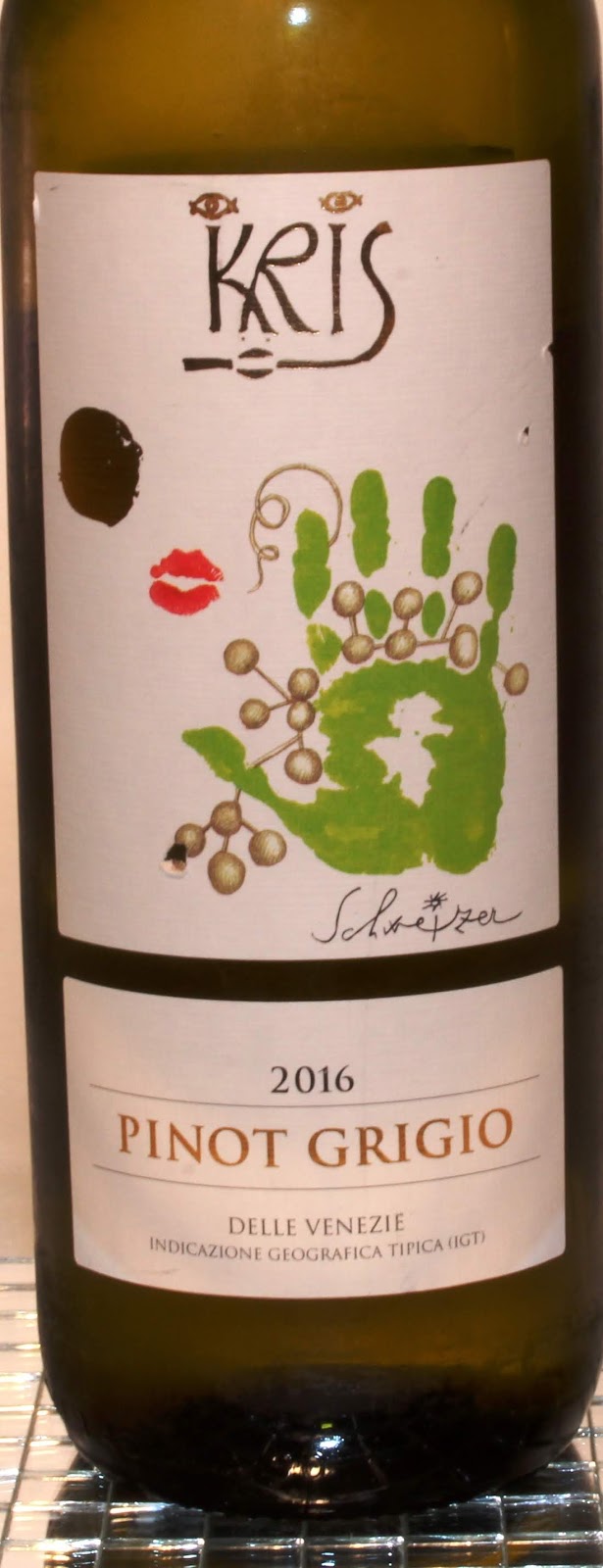


Occasionally, when I’ve poured wine, people have asked if I had any Pinot Grigio from Italy.  That’s been especially amusing when all that was on the sample table were reds.  Perhaps they thought a bottle might be obscured in an ice bucket (that was also obscured).  But regardless, I always recommended Kris.  It’s a “go-to” bottle here at “Mizer Manor” and another in my mini-series of recommended value wines.

Kris’ label has always struck me as strange.  But perhaps that is effective and its purpose.  It does standout.  Beneath the name “Kris” is a green hand print holding …. (are they) grapes (?).  Next to that is a red lipstick imprint and a gold circle.  The back-label states that “Kris Pinot Grigio’s flavor is as vibrant as its label suggests.”  Things like this make me happy I’m not in marketing. But I’ll give ‘em that the wine is vibrant.

Kris doesn’t sound Italian.  And its label is not styled in a traditional or classic Italian design. But it’s 100% Pinot Grigio and 100% from the Della Venezie region of Northeast Italy and you can’t get more Italian than that.  What you also get is a delicious Pinot Grigio that, at an ARP of $12) costs about half the price of a better-known brand.


Its nose is medium, more creamy than sharp and offers kiwi, creamed lime, floral notes (acacia) and a gentle note of mint (?).  On the palate, the lime carries on in a smooth and rounded style with interesting notes of jasmine tea and honeyed almonds.  Lemon marries lime in the mélange along with crisp apple rounded with a subtle suggestion of pear.  Other tasters enjoyed tangerine and apricot.

“Grigio” in Italian means “gray,” (attributed to the grape’s skin color). In the glass, however, the wine shows as brilliant light-lemon with a green cast.  It’s a perfect Pinot Grigio for your next picnic, lunch on the deck or summer get together.  But It’s also a wine that travels nicely from the picnic to the dining room table for more formal meals.  And I found it locally at $9.99 which should make you feel even better if you’re the one charged with buying the wine.
Quality & Character Is
Consistent From Vintage
To Vintage

Its acidity makes it food friendly with a wide variety of dishes. Creamy mushroom risotto is a natural as is any pasta in a white (or cheese) sauce (try a white cheese lasagna or Spaghetti Carbonera).  Lighter and more causally, enjoy it with a light lunch of tuna salad and fruit.  Tossed green salads?  Sure! Chicken breasts wrapped in prosciutto and stuffed with basil pesto from the garden.  Or go with your instincts and make a chicken or any style of fish piccata. Then again, it’s fine on the deck by itself at day’s end watching the sun go down.


Ramon Bautista didn’t just say it. He believed it, and he was right.  Were it not for people asking me to recommend a value Pinot Grigio from Italy, I’d not have a reason for explaining why I’ve been enjoying this brand for many years.   Thanks, Ramon and thanks to those with questions at sample tastings.  And now, if you enjoy this recommendation, you can lift a glass to Ramon too.


Alla nostra!
……………………. Jim

Follow Wine Mizer on Facebook for mini-reviews, industry news, food & wine pairings and more.

TECH SPECS AND ETCETERA
The wine is 100% Pinot Grigio but blended from the three permitted della Venezie’s regions to yield a finished wine with an expressive flavor profile.  Veneto berries provide the delicate floral notes and almond finish. From the SW facing slopes of Montagna in Alto Adige, the sunny exposure contributes fresh citrus and notes of pear.  The Mulinat estate in Friuli (soil is well drained and gravelly) produces low yielding fruit of good concentration.

Country:              Italy
Region:                Veneto        
Sub-Region         Venezie
Elevations:          330-1320 Feet
Classification:     IGT
ALC:                   12.5%
Closure:              Twist Off
Imported By:      Winebow Inc. (NY, NY)
Rating:                87 Points, Wine Enthusiast. Which Also Rated It a “Best Buy”

SANTA CRISTINA TOSCANA 2015


“Battles, unlike bargains, are rarely discussed in society.”….. James Fenimore Cooper

How times have changed since I first read The Last of the Mohicans in high school.  Today, it seems everything is fit for discussion or even viewing on the airwaves.  But on the plus side, given this lack of reservation today, it’s OK now for me to review this wine with an ARP of just $11. I can be a certified “snob” and a Mizer at the same time!  That’s a good thing because the story of this wine is an interesting one.

It begins in 1946 when Santa Cristina was introduced as a Chianti Classico by Niccolo Antinori.  Instrumental in the renaissance of Chianti, the Antinori family was involved in the famous Sangiovese, Cabernet Sauvignon and Cabernet Franc blend (“Tignanello”) that was influential in the “Super Tuscan” movement and “Solaia”, also from the Tignanello Estate.

Santa Cristina is a blend of Sangiovese (60%), with the remaining 40% coming from Cabernet Sauvignon, Merlot and Syrah and was never meant to be the others.    In 1987, with the passage of the DOCG laws (surprisingly spearheaded by Niccolo’s son, Piero), lower yields were mandated for classified vineyards. Among other things, more aging would also be necessary and doing this would alter the style and character of Cristina.

Interesting because one of the first things that struck me upon tasting this wine was its “new world” character.  Its taste is a tad sweet - attributable to rich, ripe, juicy fruit.  The nose is of mashed berry preserves. On the palate, the wine coats; thick, rich and juicy with ultra-ripe berry. A hint of cherry cola and a whispered hint of cardamom-like spice.


With the 1987 vintage, Santa Cristina moved away from the Chianti Classico designation and began adding Merlot in 1994 (10%) to the blend to make it softer and add more nuances of fruit.  The wine now is classified IGT (as were Super Tuscans anyway). While some may lament this “declassification”, I’ll opine that Niccolo Antinori knew where he wanted to go with this wine and arrived successfully where he intended.

That doesn’t mean I don’t enjoy Chianti Classico or even the Chianti from the DOCG’s 6 other sub-zones.  It doesn’t mean I don’t enjoy the dry and tannic Nebbiolo of Barolo. It does mean that there is room for all styles.  And, as I write this, I’m thinking of people whose only experience with Italian wine (other than Prosecco) has been with one of the Nebbiolo grape, maybe a Gattinara, and assumed that was representational of Italian wine.  Or maybe they found Chianti too acidic.

Italy is the land of over 900 grapes, but that doesn’t even matter in this example because – other than Sangiovese which is so widely accepted it might as well be an “international variety – the rest of the grapes are!  For those people wanting to branch out and taste the wines of the “old world,” this is your introduction.  For “old world” wine aficionados that want a “daily red’ and are in the mood to lighten the load on their palate, this is your wine also. 

With an ARP of $11 U.S., this wine is Antinori’s best value Tuscan red. I found it at $8.99 making it taste even better.  Grapes are grown on their estate hillside vineyards in Cortona, near Montalcino. Varieties are picked at different times favoring each variety’s most opportune time, then   de-stemmed and soft pressed. The must is fermented on the skins for one week (may vary) in stainless, then racked before undergoing malolactic fermentation. The result, after blending, is a “user friendly,” easy drinking red wine with red fruit and very gentle tannins. Other tasters note hints of black pepper, eucalyptus, blackberry, mint and cranberry. A wine for all seasons most definitely suitable for discussion in society.

Salute!
………….. Jim

Follow Wine Mizer on Facebook for mini-reviews, industry news and happenings.

ETCETERA
Santa Cristina:             https://www.santacristina.wine/en/
ALC:                             13%
Imported By:               Ste Michelle Wine Estates
                                    Woodinville, WA

EMILIO BULFON PICULIT NERI

"Work is love made visible. And if you cannot work with love but only with distaste, it is better that you should leave your work and sit at the gate of the temple and take alms of those who work with joy. For if you bake bread with indifference, you bake a bitter bread that feeds but half man's hunger. And if you grudge the crushing of the grapes, your grudge distils a poison in the wine.” …..   Khalil Gibran

Imagine a world in which, one by one, pigments began mysteriously disappearing and eventually, artists could paint using just one color.  And every musical instrument could only play one note: “C”.  Roses came in only one type: shrub and in orange.  And every street, everywhere, was “one way” and going in the same direction!

Front Label
If you love wine, you must love grapes. They can’t all be your favorite.  But they should all be  respected.  Many were here, the gift of nature, before we were.  And when we learned all the fun things we could do with them, some became our favorites, what are known as the “international varieties” of the wine trade.  Problem is, production follows demand.  And when demand becomes too narrowly focused, production of some wines suffers.  It becomes a spiral downward and then ….

And then there is no more.

So thanks go out to Emilio Buffon who has invested his life’s passion and resources to the revival of indigenous vines such as Cividin, Sciaglin and Ucelut (for white wine) and Forgiarin, Cjanorie, Cordenossa, Fumat and Piculit Neri (for the reds).  He discovered some of these varietals, in a state of abandon, more than thirty-five years ago, at his winery in northeast Italy. They had long been neglected, overgrown by undergrowth. Not pruned and not tended.  With government assistance, he worked to identify these vines. He worked the earth to restore it to health and propagated the vines, replanted them and eventually made wine from the varietals. Most were indigenous to this area within Italy and close to becoming extinct. At a time when “international varietals were increasingly being blended with the popularly accepted grapes of their home countries, there was little interest in this and great financial risk.  Long since forgotten, there was no “play book” for making these wines.  No taste standard.  Just trial and hopefully no errors. You poured the finished wine and a new play book opened.
 
But the thought that these gifts of nature (which were and are unique to this area at the foothills of the province of Pordenone on the banks of the Tagliamento river) were doomed to extinction in his own lifetime, that was a loss Bulfon could not be party to.  Currently, 11 of his almost 16 hectares are devoted to the cultivation of native Friulan recovered varieties. And on May 6, 1991 the Minister for Agriculture included the Forgiarin, Sciaglin, Ucelut and Piculit  Neri varieties in the National Catalogue of Vines.  

SO WHAT DOES THE WINE TASTE LIKE?
For me, it offered up an aroma of woodsy brambled berries. On the palate, a very bright tart cherry taste.  Others pick up herbaceous and smoky vanilla notes, red berries and pomegranate. One taster commentated about the wine’s “strong” (another “mild”) minerality, and a hint of blackberry and blackcurrant.  Another referenced a “milk chocolatey mocha” character. We all agreed that tannins were noticeable, but didn’t agree on the level, with me stating they were mild-plus to moderate.

Rear Label
Not having had this wine for many years and not remembering the experience, I was concerned with noting its “markers” --- those dominant characters I would remember if blind tasting this wine again and then challenged to identify it.  Good for me. Not fair to the wine, perhaps, when writing about it.  It finished crisply with a good balance of fruit to acidity.

There’s something else we can agree about and it’s that without Emilio Bulfon our world would be even more “grape franchised” than it is, and without the opportunity to explore those areas of our palate that we yet may not know can be so enjoyable. Emelio Bulfon’s work was love made visible, and we can be the beneficiaries.

Salute!
………….. Jim
Follow Wine Mizer on Facebook for mini-reviews, industry news, food pairing suggestions and more.


TECH SPECS
Emelio Bulfon Winery:          https://www.bulfon.it/en/
Production Area:                     Friuli Gave, Western Foothills
Vineyard Location:                 Colle;Pinzano al Tagliamento
                                                Valeriano; Castelnovo del Friuli
Classification:                         IGT
Training:                                 Double & Simple Guyot
Density:                                  4000 Vines Per Hectare
Number of Buds:                    12-14 Per Vine
Yield:                                      70-80 Quintals per Hectare   
ALC:                                       13%
ARP:                                       $20.
Imported By:                           Imports In., Chicago IL.
                                   
Note: 1 Quintal equals .1102 Tons and 1 Hectare equals 2.471 acres.        

Recommended (by the vineyard) Pairings: Meat dishes, game or fowl.  With its crisp acidity and bright, clean fruit, I would enjoy this, however, with an Italian style charcuterie with dry salami, hard cheese and vegetable

BLASSON WINES PINOT GRIGIO (2015)

“It is not our differences that divide us. It is our inability to recognize, accept, and celebrate those differences”  . Audre Lorde

Pinot Grigio, Pinot Gris. Same grape. Different white wines; so different in taste that many people don’t realize both are made from the same grape.  Consider Syrah and Shiraz as the same but different grape in the red category, though I think the Grigio/Gris style is even more pronounced. Here, in the U.S., the Grigio style has won the pocketbook vote of consumers. It is a light, crisp, citrusy-fruity but dry white wine that is easily enjoyed and easily affordable.  A good choice in the summer outdoors, it is picnic palatable, goes nicely with seafood in restaurants and if you open a bottle with visiting friends everyone will be comfortable with it.  No wonder it became so popular!

Northeastern Italy is the epicenter of Pinot Grigio viniculture
About as far northeast as you can go.
and production. Here the cool temperatures assure grapes of increased acidity to provide the mouthwatering finish that consumers love.  Since the grape itself is not naturally high in acid, grapes in Friuli, Venezia, and Guila are picked early (thankfully not so as to make for an offensive vegetative character – timing is everything) while acids are relatively high and sugar not at its peak. Fermentation and storage is traditionally done in stainless-steel tanks in order to preserve freshness, fruit and the “zing” quality of Grigio.  Seldom is oak used as it would add weight and tertiary notes not consumer associated with the style.  Pinot Gris, with grapes ripened, is rich and weightier. It is heavier in mouthfeel and (for me) makes a better match for some fish meals. 

I enjoy both styles.  Each serves its purpose. But I know from experience that success breeds imitation and over production and waves of watery thin and quaffable but overpriced Pinot Grigio have washed ashore.  I wanted something different.  Yes, there’s a PG or two out there that have become my “go-to” Pinot Grigios.  But, tasting wine as frequently as I have comes with the potential of jading the palate and I wanted something different. It was time to experiment. Pinot Grigio, yes, but not my “go to” wine.  Different, but same.  Fortunately, I found what I was looking for within the glass of a bottle of Blasson Wines’ Pinot Grigio (2015).  As for northeast Italy, Giovanni Blasson’s winery is only ten miles from Italy’s eastern border with Slovenia. About as far northeast in cool temperature Italy as you can go. His D.O.C. Pinot Grigio immediately commanded my palate’s attention as most PG wines have not for sometime. Yes, this was Pinot Grigio. The nose offered Meyer lemon, ripe-ripe pear, salinity and notes of white flower, but all so reserved. I know tasters that referred to a nose that “jumped” from the glass, but that was not my experience. This was refined, subtle, and artful. I was interested.

Then came texture. Pinot Grigio is, for me, not a palate weighted wine.  But this had body. It had texture like a Pinot Gris. Still, the fruit was there; all the traditional fruit so expected of Grigio: lime, lemon (Meyer), kiwi, and fresh cut red apple and with a whisper of melon (orange).  It finished with a bitter green apple taste. For a Pinot Grigio, this was becoming complex. The acidity was there, but – like the fruit – melded into a tapestry of elegance and reserved finesse.  Blasson juice is never oaked, but benefits from gentle lees stirring which accounts for the richness and adds elegance, while maintaining the expected fruit of the style. Found at Vin Chicago for $10 retail, it didn’t just excite my palate, it pleased my pocketbook.  It was different. It was good. It was a positive palate exciting experiment I will be repeating.

Cent' anni 
……………..Jim
Wine Mizer is not a “dba” because it does not do any business. Truth be told, it is a not-for-profit non-corporation, money-losing sole-proprietorship venture.  Such assures you, however, that opinions are unbiased. Wine Mizer accepts no advertisements. Support this venture by “Liking” Wine Mizer on facebook.

Are you up to a wine crossword puzzle challenge?  Like Wine Mizer on facebook. You’ll also enjoy industry news, mini wine reviews, recipes, food and wine pairings and more!

INCIDENTAL INFO
Azienda Agricola di Giovanni Blason
Estate Bottled
Country: Italy
Region: Friuli-Venezia Giulia
Sub Region (Appelation): Isonzo del Friuli D.O.C.
Alc: 12.5%
Imported by: Terraneo Merchants: